 admin
admin “A hire I have wanted since the very beginning of OpenAI.” — Sam Altman, OpenAI CEO
If you want to understand why Noam Shazeer’s move to OpenAI matters, you need to understand one single paper published in 2017 called ‘Attention Is All You Need.’ That paper introduced the Transformer architecture — the mathematical foundation that powers every major AI system you use today. ChatGPT? Transformer. Google Gemini? Transformer. Claude? Transformer. Siri? Now a Transformer too.
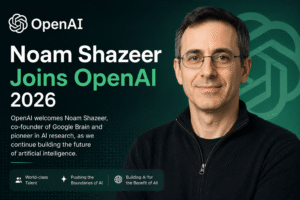
Noam Shazeer co-wrote that paper. On June 18, 2026, he announced he is joining OpenAI as Lead for Architecture Research — the person who will design the structural foundations of the next generation of GPT models. This is the most consequential AI talent move of the year, and possibly of the decade.
Who Is Noam Shazeer and Why Does He Matter So Much?
Shazeer spent years at Google Brain, where he became one of the most respected AI architects in the world. After co-authoring the Transformer paper in 2017, he left Google in 2021 to co-found Character.AI — the conversational AI startup that attracted hundreds of millions of users with its AI character chatbots.
In 2024, Google paid approximately $2.7 billion to bring him back in a headline-making deal that stunned the AI world. He lasted less than 22 months. Now he is at OpenAI, where Sam Altman called it a hire he had ‘wanted since the very beginning of OpenAI.’ The AI talent war just escalated to a new level.
What Does This Mean for GPT’s Future?
As Lead for Architecture Research at OpenAI, Shazeer will design the structural foundations — the actual neural network architectures — that determine how capable the next generation of GPT models can be. In simple terms, he will be the person deciding how OpenAI’s AI thinks.
The follow-on question worth tracking is whether Google’s Gemini release cadence slows in the second half of 2026. Shazeer was central to Google’s model architecture strategy. His departure, from a company that paid $2.7 billion to keep him, is a significant blow — even if Alphabet’s shares closed up 1.17% on the day, suggesting markets believe Google’s scale remains formidable without him.
The Other Big AI Story This Week: GLM-5.2 and the Export Control Crisis
While the Shazeer news dominated AI headlines, another story has massive practical consequences. On June 12, 2026, the US Department of Commerce issued an emergency export control directive that banned global access to Anthropic’s Claude Fable 5 and Mythos 5 models — two of the most advanced AI systems ever released — on national security grounds. As of today, June 23, they remain offline.
Into this vacuum stepped GLM-5.2, released by Chinese AI lab Zhipu AI (Z.ai) under a fully open MIT license with no regional restrictions. Its benchmark numbers are extraordinary: a SWE-bench Pro score of 62.1 — beating GPT-5.5 at 58.6. Its API cost is $1.40 per million input tokens, compared to GPT-5.5 at roughly $30 per million output tokens. For developers locked out of Fable 5, GLM-5.2 has become the de facto alternative — and it is Chinese-made.
The export control crisis is unintentionally accelerating global AI diversification. When the US restricts its most powerful models, the world finds alternatives. That is the unintended consequence regulators are now grappling with.
Agentic AI: The Trend That Will Define the Next 3 Years
According to Gartner, 40% of enterprise applications will integrate AI agents by the end of 2026. McKinsey reports that 62% of organizations are experimenting with agents, but only 23% have successfully scaled them. The gap between testing and scaling is where the real business opportunity lies right now.
A striking real-world example: OpenAI and Boston Children’s Hospital revealed this month that integrating AI cognitive systems across the hospital’s clinical workflows saved over 60,000 hours of manual administrative time, with more than one-third of staff interacting with AI tools daily. This is what agentic AI looks like when it actually works in practice.
Key Takeaways for June 23, 2026
- Noam Shazeer, co-author of the Transformer paper, has joined OpenAI as Lead for Architecture Research — the biggest AI talent move of the year.
- GLM-5.2 from Zhipu AI outperforms GPT-5.5 on key benchmarks and costs 6.8x less — with no regional restrictions.
- Claude Fable 5 and Mythos 5 remain offline due to US export controls, entering paid usage-credit billing today.
- 40% of enterprise apps will include AI agents by end of 2026, but most companies are still in the testing phase.
- AI saved Boston Children’s Hospital 60,000+ hours of administrative work — real-world proof that agentic AI delivers results.